There is no phone signal inside Portencross Castle. That turns out to be the most important thing about shooting there.
At eight on a Monday evening in August, Jim Craik from the Friends of Portencross Castle unlocked the door and we carried everything up the stone stair — a model, a makeup artist, a photographer, two candelabras and a bag of LED candles. Then the door closed and the world outside went quiet. No notifications. No calls. Just stone that has stood on this rock for six and a half centuries, and two hours to make something worth the drive.
Six Centuries of Standing Still
The rock came first. Around 400 million years ago a mountain range the size of the Himalayas rose across northwest Britain, and over the next forty million years it wore back down into the red sandstone you still see along this shoreline. The castle is built from that same stone, quarried within sight of where it stands.
People have been watching the sea from this headland for close to three thousand years — an Iron Age fort on the hill behind, then a Roman harbour two kilometres north, then a motte-and-bailey castle held by the de Ross family. Whoever holds Portencross sees who is coming up the Clyde.
In 1315, the year after Bannockburn, Robert the Bruce took these lands from the de Ross family and gave them to Sir Robert Boyd of Kilmarnock as payment for loyalty. Around 1360 the Boyds abandoned the hill fort and built a new tower down at the water's edge — the building we shot in.
Then comes the part that earns Portencross its national importance. Robert Stewart grew up in these parts, and when he became Robert II, this castle became a working royal address. Fifteen charters were dated at Arnele between 1371 and 1390 and were almost certainly signed inside these walls. One of them settled the inheritance of much of northwest Scotland and the Western Isles. For a couple of decades, the business of the Scottish crown was conducted in a tower on a rock in North Ayrshire.
By the 1400s the kings had stopped coming. The Boyds stayed until around 1660, then moved somewhere more comfortable and local fishermen took over the castle. In January 1739 a gale took the roof off, and that was effectively the end of it as a building — a ruin for the next two and a half centuries.
What saved it was a group of local people. The Friends of Portencross Castle formed in 1998, spent seven years working towards ownership, and finally took the castle on in December 2005. They raised just over a million pounds, and the conservation work ran from 2009 to September 2010 — cantilever scaffolding that touched the sea walls without being fixed to them, every stone photographed before it was moved so it could go back exactly where it came from, and a spiral stair that had to be redesigned to hang from the roof beams when investigations found a bottle dungeon under the floor.
And the work never really stops. Standing inside it, what struck me was how hard this building must be to keep. It sits on rock a few metres from open sea, taking salt spray and Atlantic wind year round, in a country where the weather changes its mind four times in an afternoon. When something needs repairing you cannot simply order stone — it has to be matched to what the medieval masons used, which means the right quarry, the right colour, the right grain, and then the wait. The restoration team needed three separate stones to do it properly. Every repair is slow by definition.
That is what makes the Friends' work quietly remarkable. Keeping a six-hundred-year-old tower standing on an exposed Ayrshire headland, in the twenty-first century, largely on donations and volunteer hours, is not a project that ever finishes. They have also brought it genuinely into the present — there is electricity in the building now, and free WiFi for visitors, which for a scheduled ancient monument on a sea rock is not a small thing.
There is also a local story that the kings of Scotland lay in state here on their way to burial on Iona. Nobody has produced the evidence, and the Friends themselves put it to schoolchildren as an exercise in telling history from legend. I photographed the place with the story in my head anyway.
The Shoot
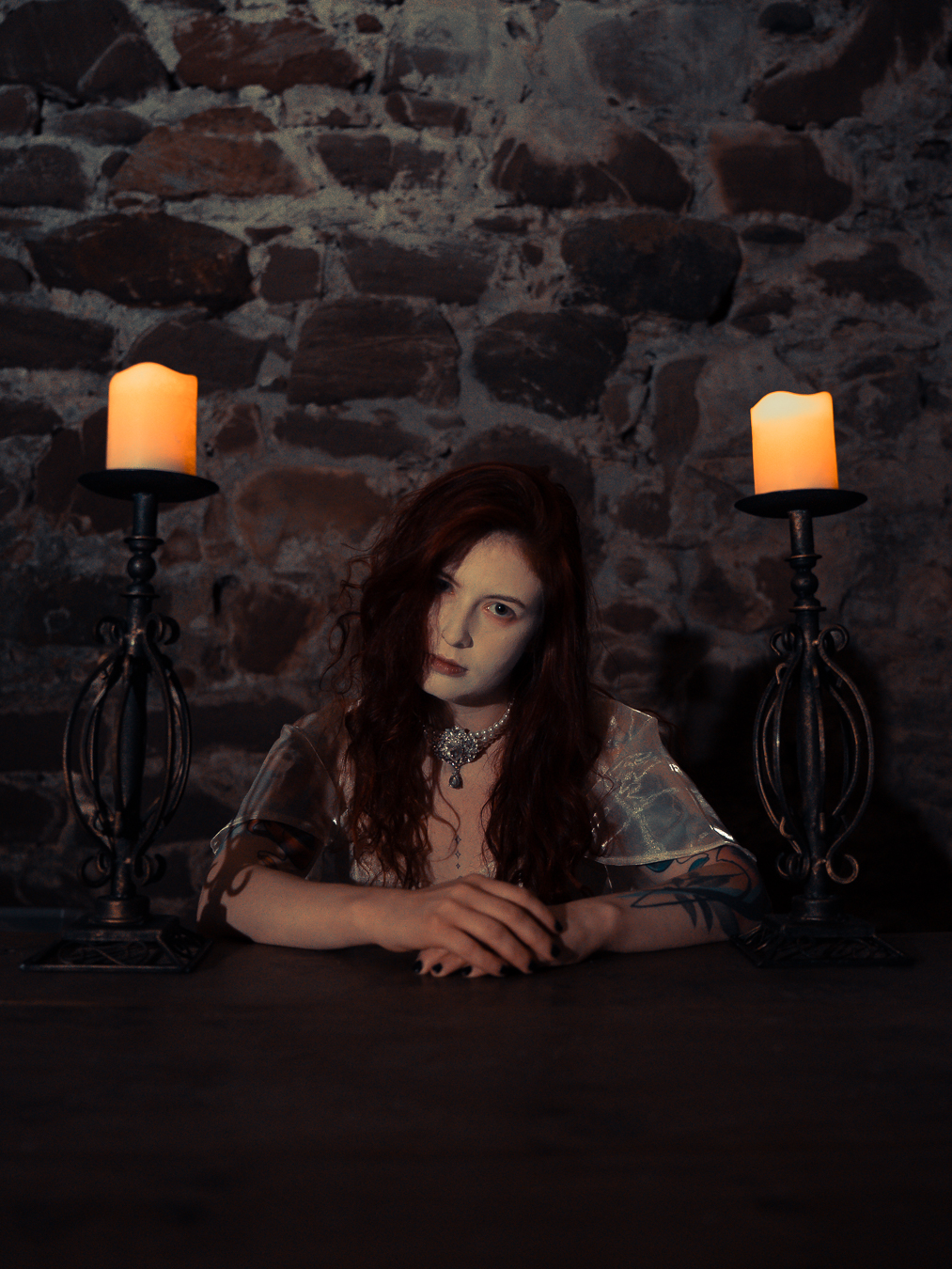
The concept was simple enough to survive contact with the building: a woman who might have been standing in this room for a very long time.
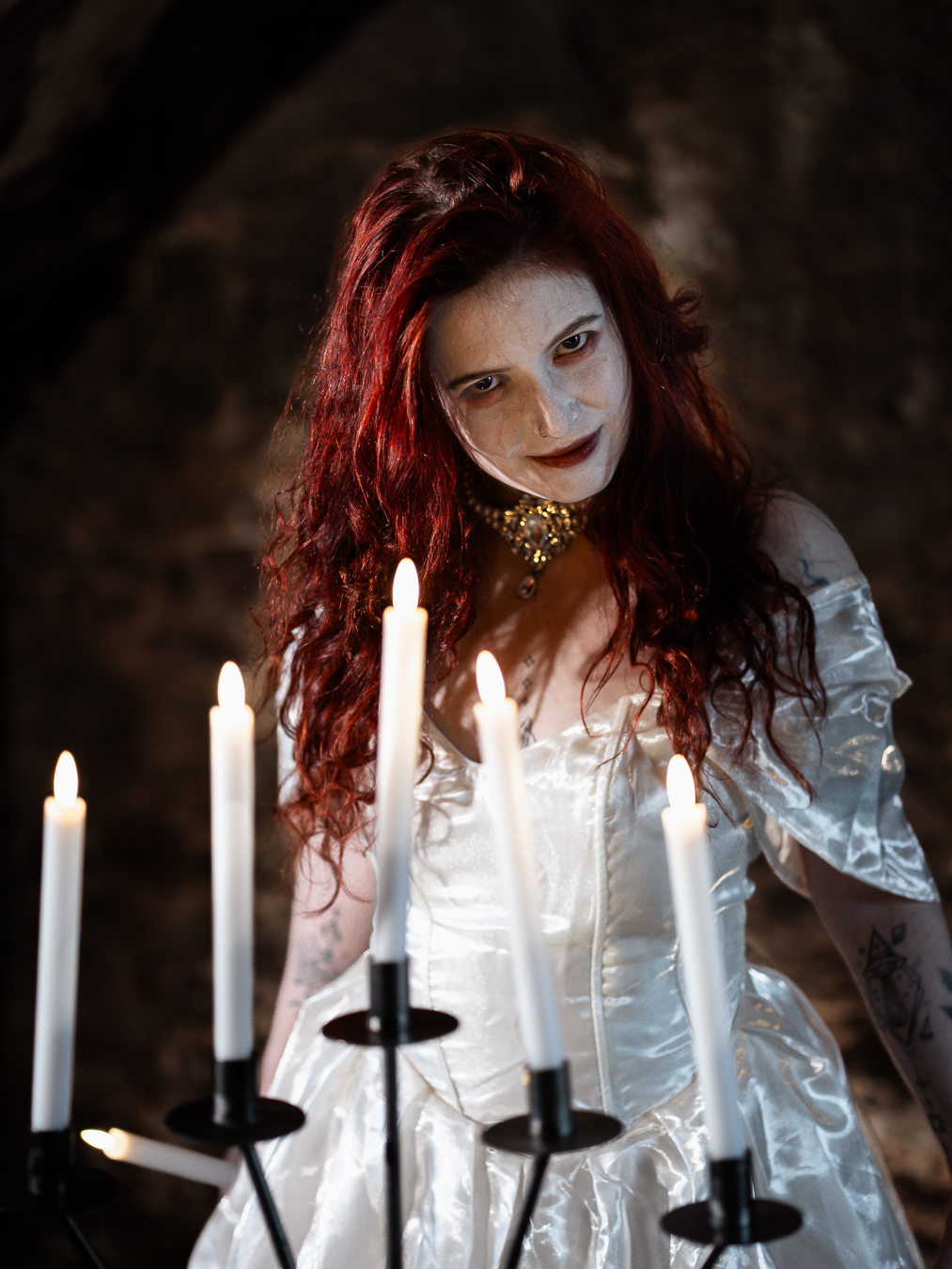
Jess arrived in an ivory-champagne satin corset gown. Karolina built the makeup beforehand — pale, ethereal, not quite alive. We brought a five-candle floor-standing candelabra just over a metre tall, an ornate pair of pillar holders, and LED candles throughout, because open flame inside a scheduled ancient monument is not a combination anyone sensible agrees to.
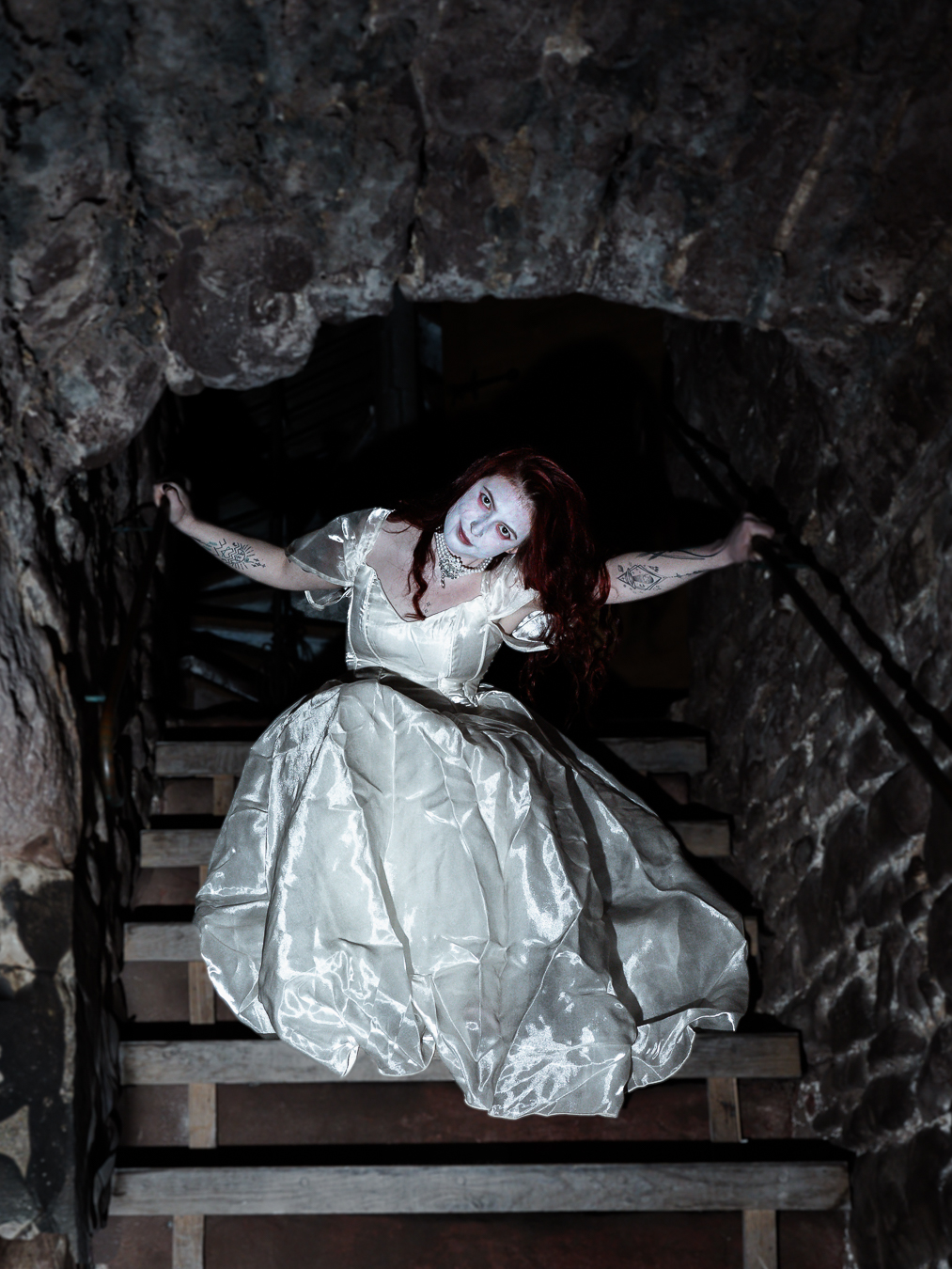
Two hours is not long. What the castle gives you in return is a set nobody could build: a pointed stone archway with a carved Viking longship panel above it, walls of red sandstone that swallow light, a timber stair rising into the dark, and rooms with no ambient light at all once the door shuts.
That last part is both the whole problem and the whole opportunity. In a room that dark, anything you light becomes the subject by default, and anything you don't light stops existing. The frames that worked are the ones where I let most of the image fall to black and kept the light on two things only: Jess's face, and the flames.
The ones that didn't work are the ones where I got greedy and lit the dress.
With Thanks
To the Friends of Portencross Castle for the access, and for two and a half decades of unglamorous work that means there is still a building here to photograph. To Jim Craik for opening up for us on a Monday evening. To Karolina for the makeup, and to Jess, who held her stillness for two hours in a cold stone room and never once broke the mood.
Scotland has a handful of castles everyone photographs. Portencross is not one of them, and that is exactly its appeal — a genuine hidden gem, forty-five minutes from Glasgow, with Arran sitting on the horizon and almost nobody there. If you shoot, or you just want somewhere quiet with six centuries in the walls, put it on the list.
Visiting, and Hiring the Castle
Entry to Portencross Castle is free — the Friends run it on donations, volunteer hours and events, because the restoration grants covered the building but not the upkeep. Inside there is electricity, free WiFi, cellar displays and a roof-top viewing platform looking across to Arran.
The castle is also available to hire — for weddings, renewal of vows, christenings, engagements, private hire and as a film or photography location. Enquiries go to events@portencrosscastle.org.uk, or through the castle's Facebook page. General enquiries: fopc@portencrosscastle.org.uk · 01294 823799.
- Website: portencrosscastle.org.uk
- Castle hire: portencrosscastle.org.uk/castle-hire
- Hire enquiries: events@portencrosscastle.org.uk
- Facebook: Portencross Castle
- SatNav: KA23 9QA
If you want a look inside before you go, The Castle Girl has a video tour of Portencross on YouTube — worth watching for a sense of the scale of the place. You can also support the castle directly by becoming a Guardian of Portencross Castle — details on their website.
Model: Jess · SFX makeup: Karolina Kotwicka
Location: Portencross Castle, North Ayrshire — by kind permission of the Friends of Portencross Castle