No car, no fixed shot list — just a walk. We started among ruined stone, passed through a quiet corner of remembrance, and finished down at the harbour, letting the town's own history carry the day.
Before the Shoot
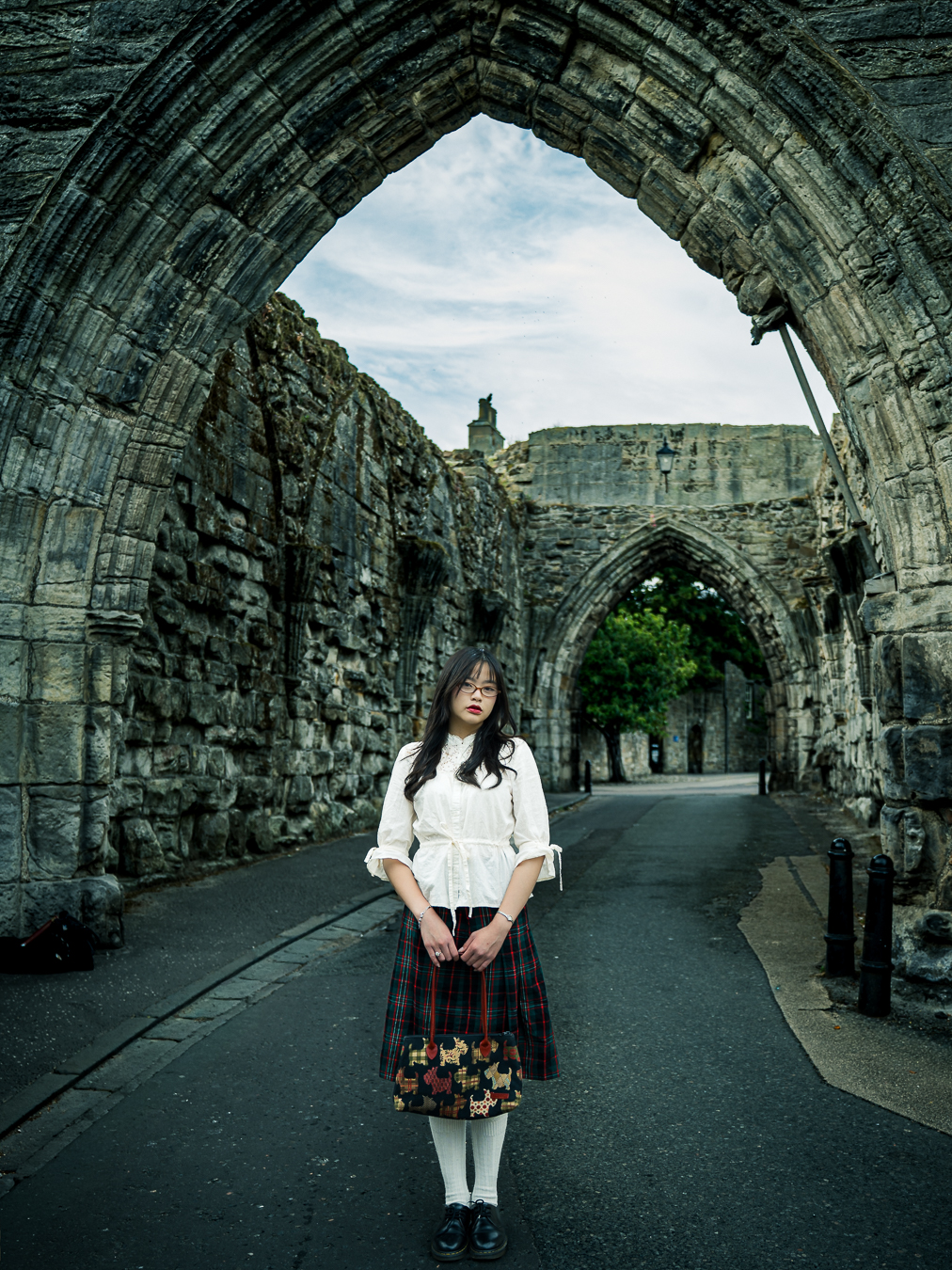
The plan started simple: a walk, not a fixed shot list, built around three stops in old St Andrews. The mood was set early — dark academia, leaning into old stone and quiet light rather than anything polished. The look followed from there: a cream lace top under a long dark coat, plaid skirt, knee socks and Mary Janes, with an oxblood/berry lip as the one warm note against all that grey stone. A worn hardback book and a leather satchel came along as props — the kind of quiet detail that makes a shoot feel like a scene rather than a portrait.
The route: start at The Pends, walk through the gate to the Cathedral Burying Ground, then on down to the harbour — letting the town's own history do a lot of the work.
Chapter One — The Pends
The Pends is a pair of ribbed stone arches at the east end of South Street — all that remains of the great 14th-century gatehouse that once controlled entry to St Andrews Cathedral's Augustinian priory. In its day it was a working building, not just a ruin: a porter lived in rooms above the archway, and its small decorative arches were designed to echo the cathedral's own west front. When the Reformation swept through St Andrews in 1559, the priory and cathedral were stripped and abandoned, and within a few decades The Pends had lost its roof for good — one of the best-preserved fragments of a religious complex that was once among the largest and most powerful in Scotland.

Chapter Two — A Quiet Pause
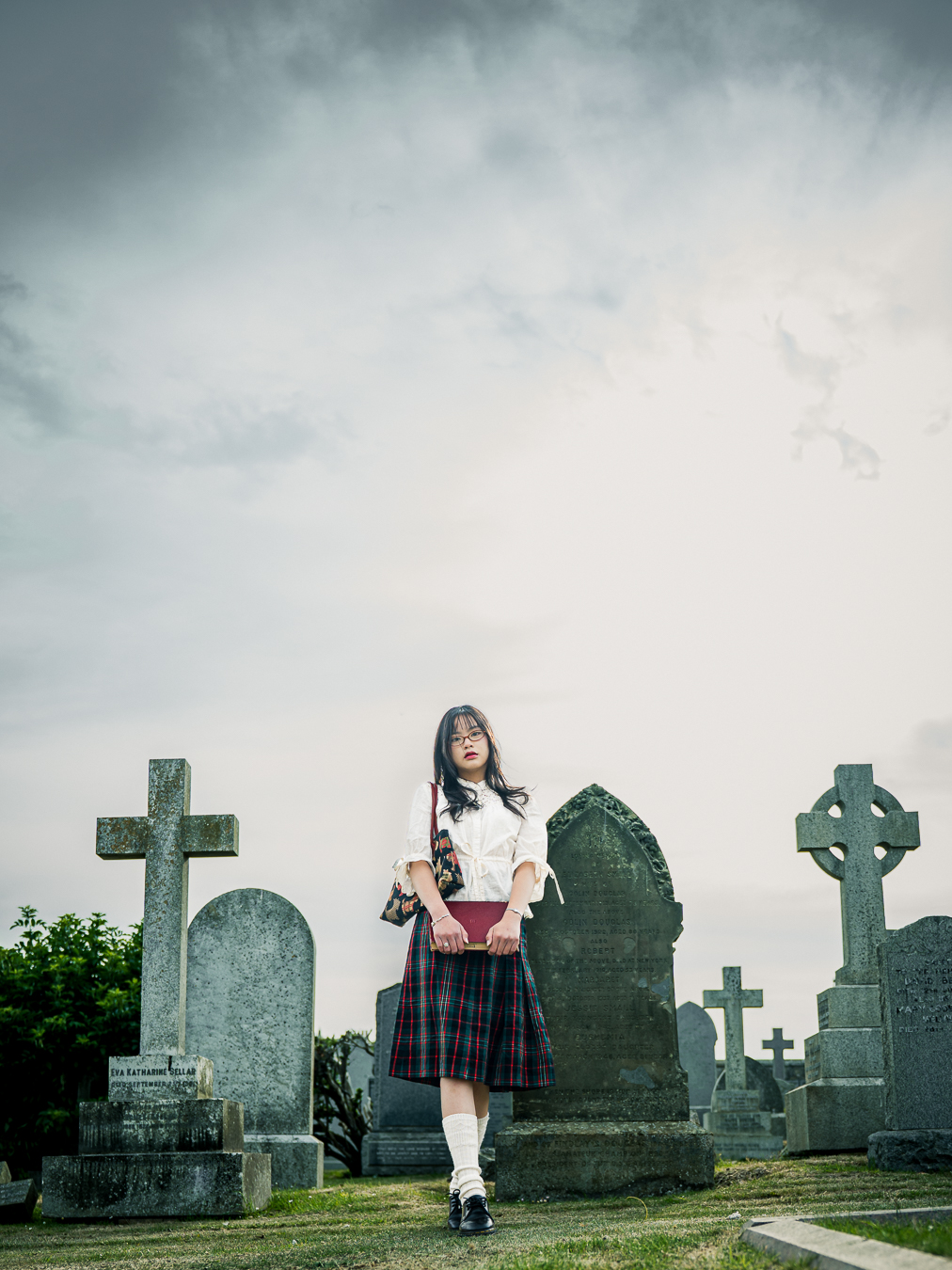
From The Pends we walked through the gate into the Cathedral Burying Ground — the graveyard that grew up around the ruined cathedral itself. Tucked among the older headstones are two Commonwealth war graves, tended in perpetuity by the Commonwealth War Graves Commission, part of a wider quiet presence across St Andrews' cemeteries marking local servicemen from both World Wars. We didn't shoot much here — it felt right to just slow down and look.
Chapter Three — The Harbour
From the graveyard we carried on down to the harbour, tucked below the cliffs at the back of the cathedral grounds. There's been a fishing harbour here since at least 1222, and by the medieval period it was trading with the Low Countries and could hold as many as 300 vessels at once — one of the busiest ports on this stretch of coast. The harbour has always been bound up with the cathedral next door: when the main pier was rebuilt in stone in 1656, much of that stone was taken from the ruined cathedral itself. The same walls we'd just walked through, holding the town together in a different shape.