I sent the gallery over feeling good about it. Leah came back and said the edits were too bright. She was right.
We met at half five on a Saturday in October, which is late enough in the year that dusk does most of the work for you. Dusk rather than morning for a practical reason: Leah does her own makeup, always has, and it takes hours. There is no point asking someone to be camera-ready at seven in the morning when the look they build is the whole point.
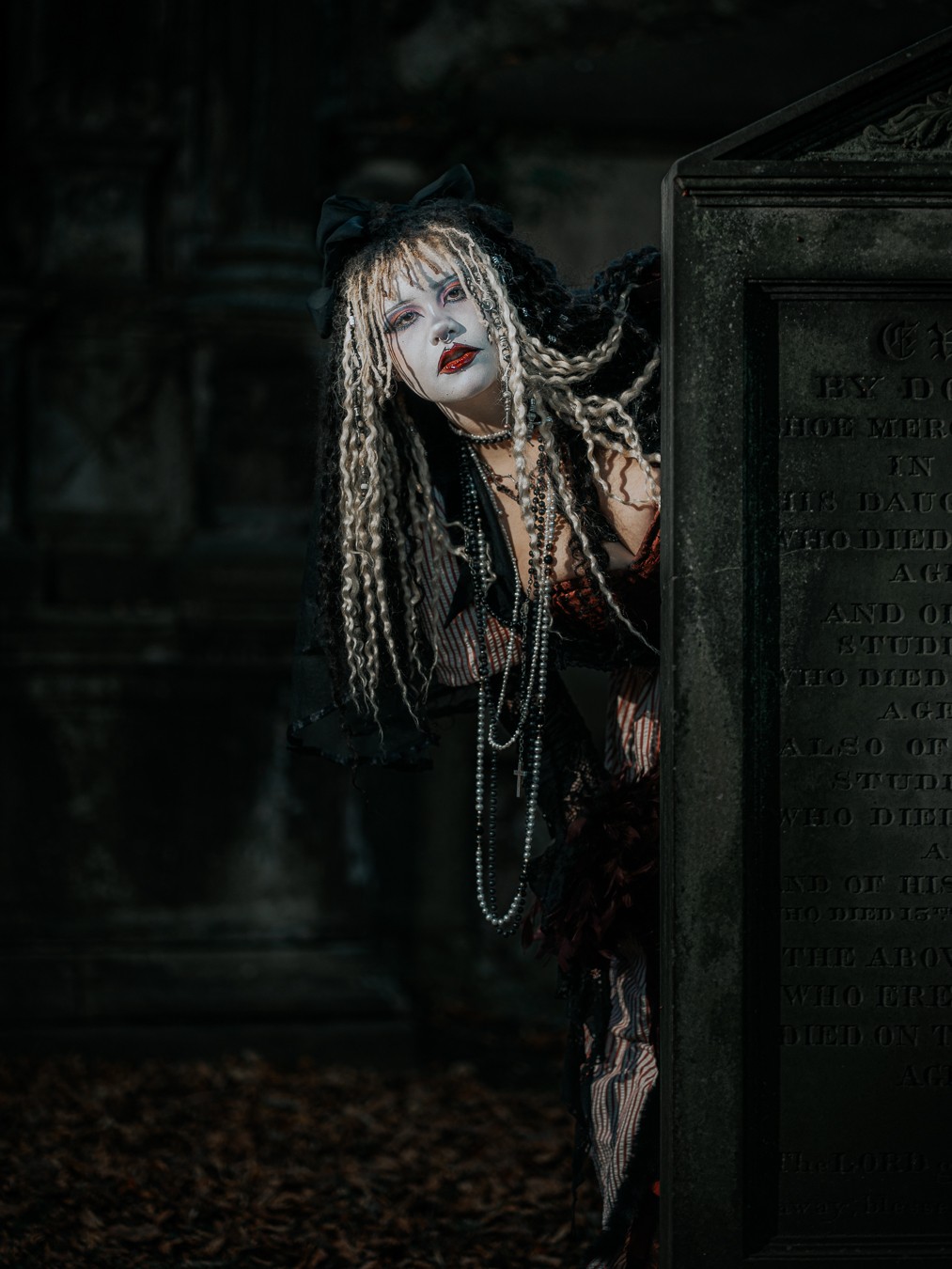
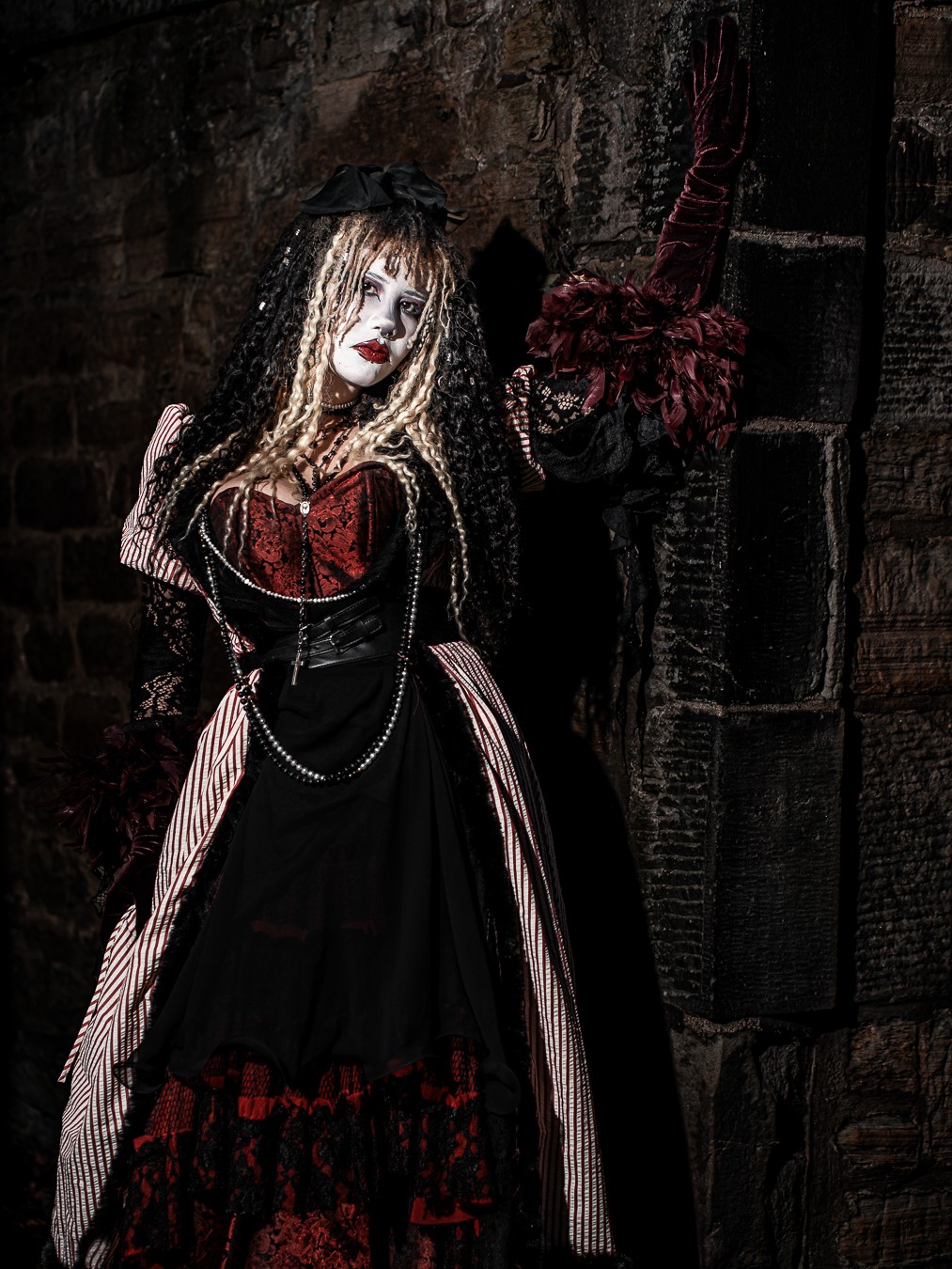
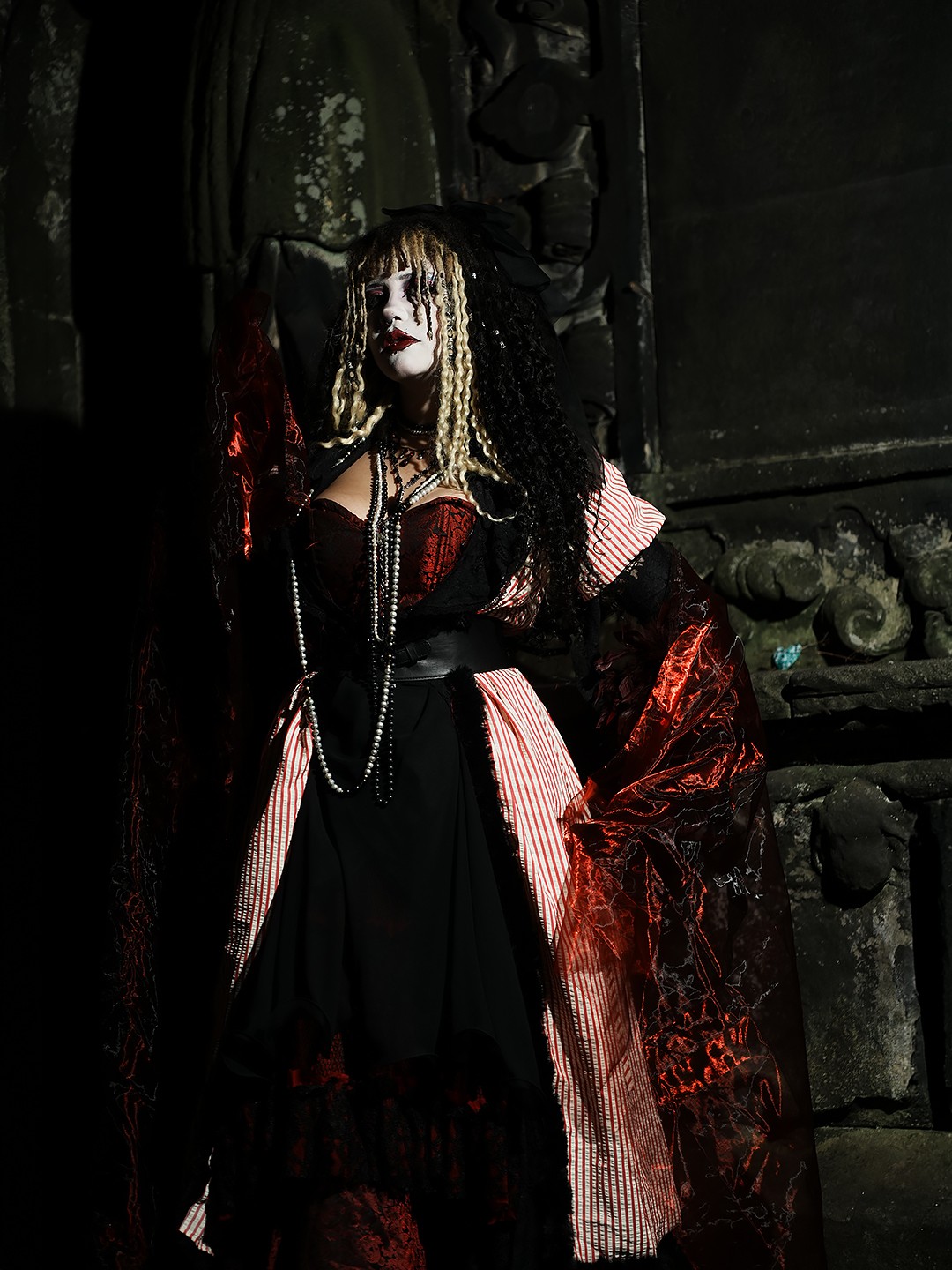
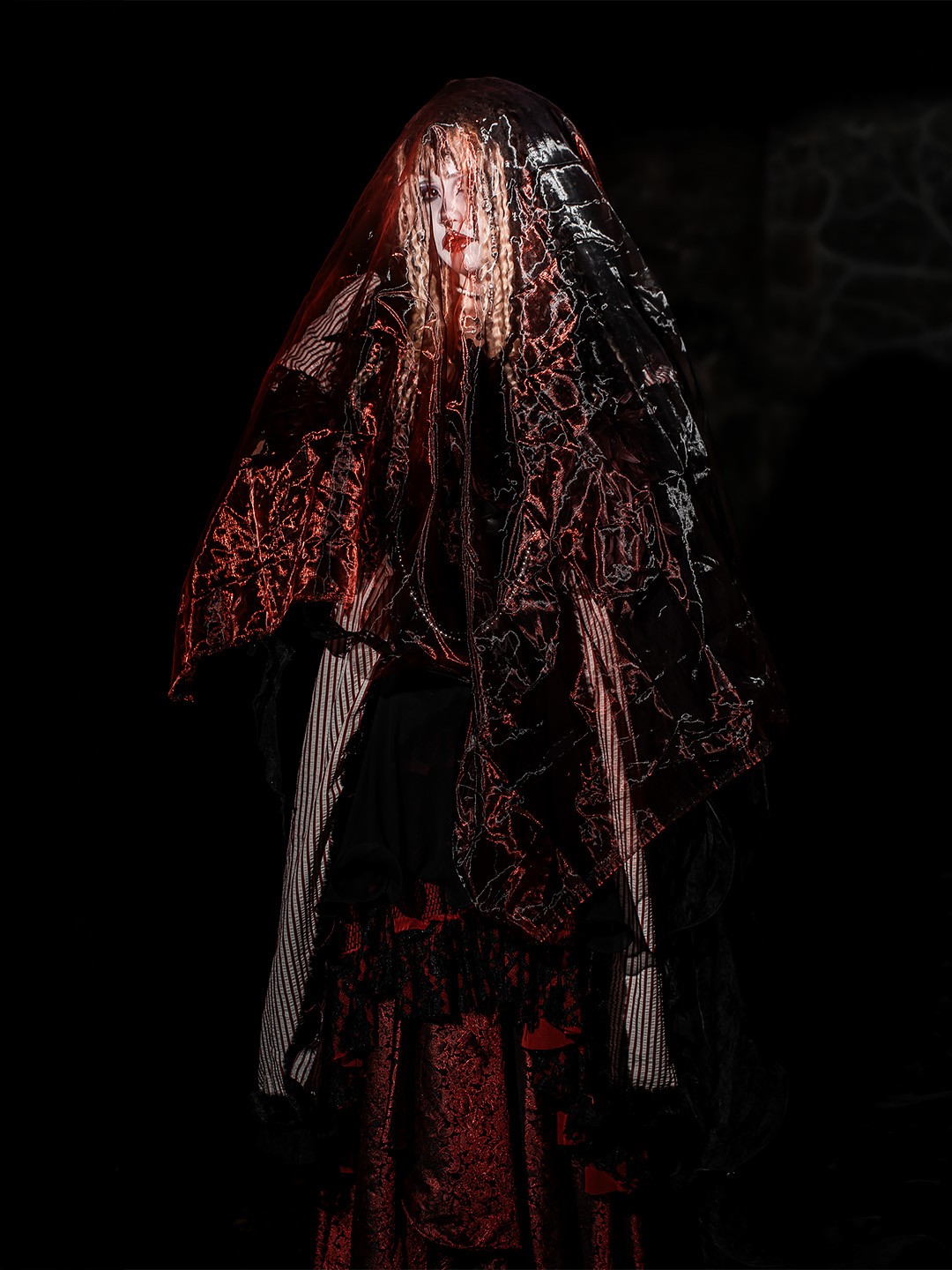
She wore burgundy and black, floor length and layered, with a translucent red veil she could pull over her head or hold out at arm’s length. Her face was painted white, brows drawn in, mouth red. That is the part that takes the hours. She layers everything — it is how she dresses, not a styling note I gave her — and it is the reason the frames hold together. The colour sits almost exactly between the sandstone and the shadow.
A Burial Ground Built on a Friary
Greyfriars was never meant to be the romantic place it has become. It exists because Edinburgh ran out of room to bury its dead. The burgh council resolved in April 1561 to change the city’s burial arrangements, and the kirkyard was founded in August 1562 to replace the ground at St Giles’, which fell out of use around 1600.
The land had belonged to a Franciscan friary, dissolved in 1560 — the grey friars the place is named for. So the ground was already old and already religious before a single headstone went into it.
What makes it extraordinary to photograph is the wall. Along the east and west edges of the old northern yard stand some of the finest early seventeenth-century mural monuments in Scotland, carved thick with the symbolism of mortality and immortality: the Death Head, the Angel of the Resurrection, the King of Terrors. These are not subtle. They were not meant to be. The whole kirkyard is Category A listed, and standing among them at dusk you understand why.
The Covenant, and What Came After
On 28 February 1638, the National Covenant was signed in Greyfriars Kirk. The kirkyard mattered to that moment for a dull and very Scottish reason: it was a place of free legal public assembly. You could gather there lawfully when you could not gather elsewhere. The flat table stones you see in the paintings of the signing were not there yet — that detail came later, added by artists who liked the composition.
What came after is the part that sits heaviest in the ground. After the Battle of Bothwell Bridge on 22 June 1679, around twelve hundred Covenanter prisoners were brought to Edinburgh. The tolbooth and the castle could not hold them. Roughly four hundred who could not be housed anywhere else were put in a field immediately south of the kirkyard, enclosed by the Flodden Wall on two sides, the high wall of George Heriot’s School on the west, and a guarded picket fence on the kirkyard side.
A field, four walls, and four hundred people. That is the Covenanters’ Prison. The vaults that stand there now were not built until afterwards. Most of the ground was later built over by Bedlam around 1690, and the strip that survived went back to being used for burials from about 1700. It was locked up around 1990 after years of vandalism.
We did not shoot in there. Partly because it is locked, and partly because there is a line between a location with history and a location where something specific and terrible happened to four hundred named people. The kirkyard carries enough without standing on that bit of it.
Iron Over the Graves
The other thing you notice is the ironwork. Enclosed lairs with stone walls and iron railings, mostly along the south edge, and two low iron mortsafes still in place.
These were not decoration. In the early nineteenth century the resurrection men were supplying Edinburgh Medical College with bodies for dissection, and a fresh grave in a city-centre kirkyard was an obvious place to find one. A mortsafe was a cage bolted over a coffin, left in place for the weeks it took a body to become useless to an anatomist, then lifted and reused for the next burial. Families who could afford one bought a few weeks of being left alone.
There is also the Mackenzie mausoleum — Sir George Mackenzie, Lord Advocate, died 1691, in a domed Italianate tomb by James Smith modelled on Bramante’s Tempietto in Rome. It has a reputation attached to it that I am not going to repeat as fact, because the stories are stories. What is on the record is more ordinary and somehow worse: in 2003 two teenagers got in through a ventilation slot at the back, broke open the coffins and took a skull. The police found them playing football with it. The slot is sealed now.
Too Bright
Here is the part I keep thinking about.
I shot it the way I shoot most things lately — letting the frame fall mostly to black, keeping the light on her face and the dress. Then I edited the selects the way I normally edit: lifted the shadows a little, opened up the darker corners, brought back some detail in the stone.
Leah sent back five picks and told me, politely, that they were too bright. She wanted them darker. She wanted the shadows left exactly where they fell, unlifted, because the darkness was the mood and I had been quietly undoing it.
So the set went out unedited, at her request. The raw frames, balanced and nothing else.
They are better. That is the annoying bit. Every instinct I have says a photograph needs opening up, that detail in the shadows is a mark of care — and in a kirkyard at dusk in October, with four centuries of carved skulls on the walls, it is exactly the wrong instinct. The shadow is not a problem to be solved. It is the subject.
I learned a version of this at Portencross in August and apparently needed telling again.
With Thanks
To Leah, who did her own makeup, brought her own wardrobe, held a mood for an hour in a cold graveyard in October, and then had the nerve to tell me my edits were wrong. The set is better for it.
If this one is your kind of thing, the candlelit gothic shoot at Portencross Castle came first. Same mood, different coast.
Shooting at Greyfriars
Greyfriars Kirkyard is open to the public and free to walk through. It is a working burial ground and a Category A listed site, so a few things are worth knowing before you plan a shoot there.
- It is busy. Greyfriars Bobby’s statue sits at the gate on the corner of George IV Bridge and Candlemaker Row, and the kirkyard is on most Old Town walking tours — early morning or dusk gives you the quiet.
- Dusk in October falls around half five, which is late enough to light properly and early enough that you are not shooting in full dark.
- The Covenanters’ Prison at the south end is locked, and access is normally only on a guided tour.
- It is a cemetery. People visit graves here. Keep the kit small, keep out of the way, and do not climb on anything.
- Commercial shoots should be cleared with Greyfriars Kirk — worth a call before you turn up with a crew.
The best frames are along the east and west walls of the old northern yard, where the seventeenth-century mural monuments are.
Model, styling and makeup: Leah
Location: Greyfriars Kirkyard, Edinburgh