A saree is six yards of silk built for heat and monsoon. Glencoe in August is neither. That is most of why I wanted to do it.
Roselitta and I are both Malayali, which is how the idea started rather than how it was planned. I had been carrying a frame around for months — someone barefoot on wet stone, silver at the wrist and the waist, hills stacked up behind. I had pitched it at Loch Ard. Then Loch Lomond. It kept not quite fitting, and I kept not knowing why.
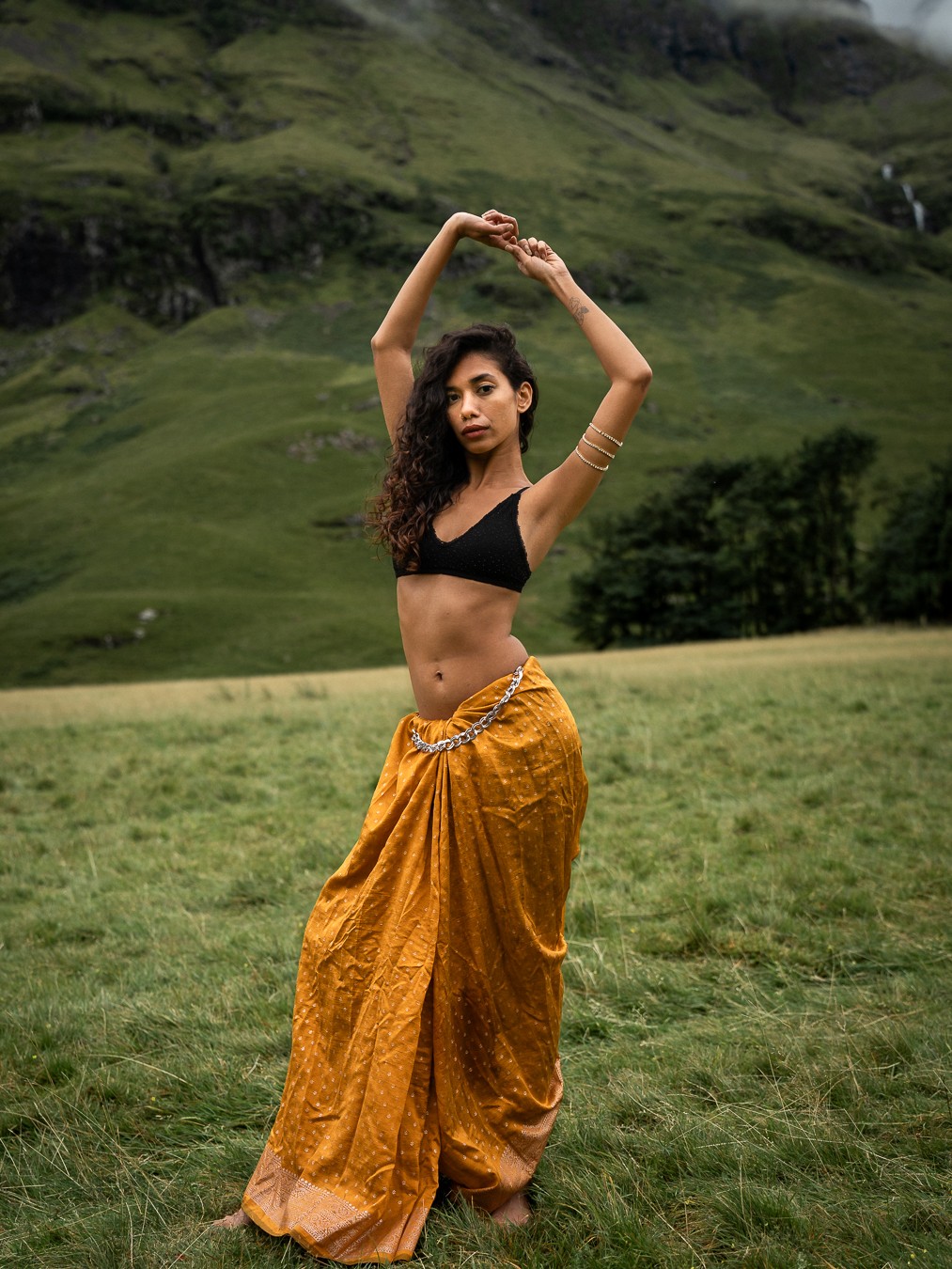
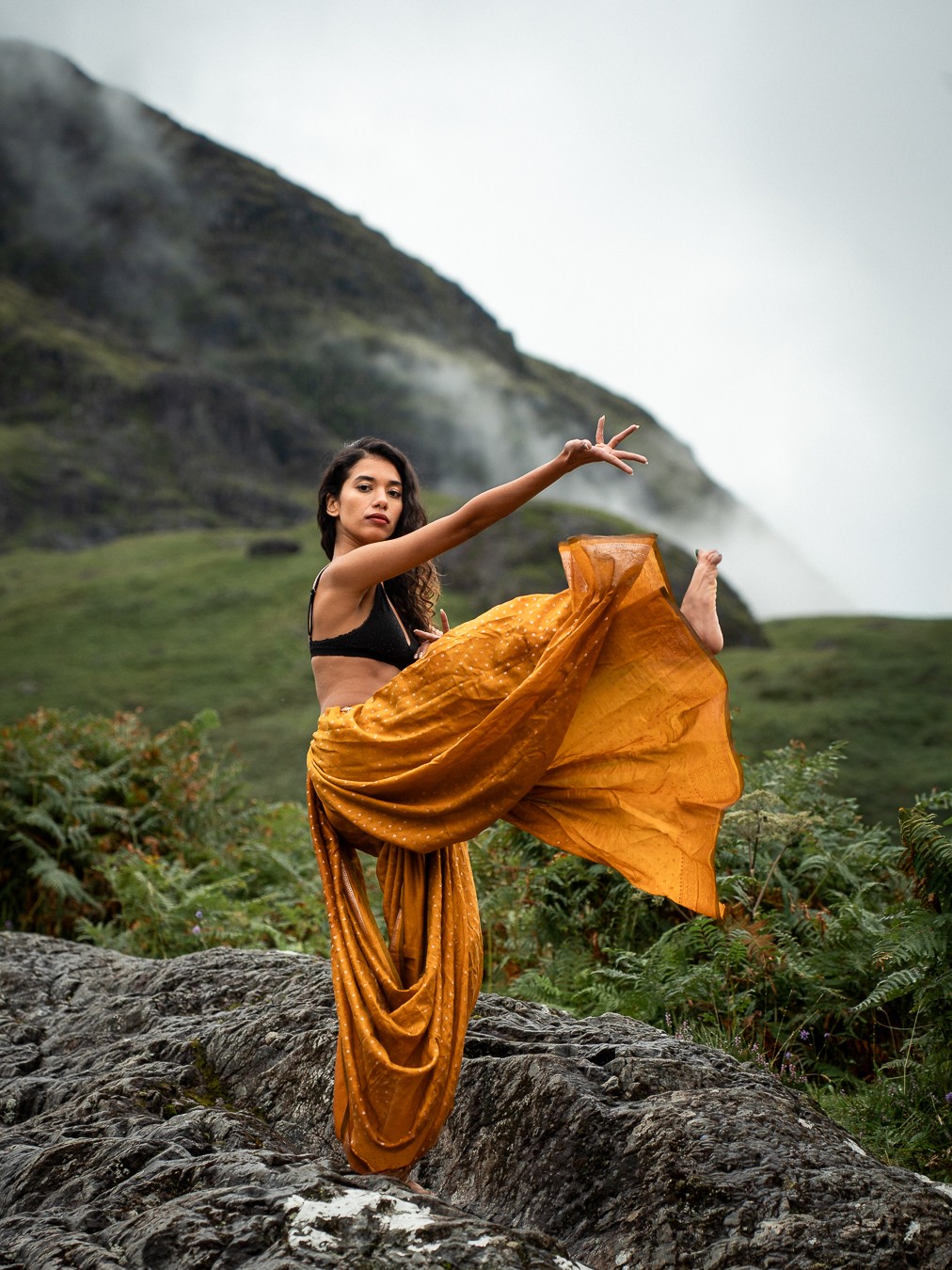
Glencoe fixed it. The thing a loch gives you is stillness. The thing Glencoe gives you is scale, and scale was what the frame was missing. A saree is already a big garment — it moves, it has length, it does things in wind that a dress cannot. Put it somewhere small and it takes over the picture. Put it in Glencoe and it finally has something to answer to.
A Glen Made by a Collapsing Volcano
The rock here is what is left of a supervolcano. The caldera-forming eruptions happened around 420 million years ago, in the Silurian, and the volcano has been extinct for essentially all of the time since. What survives is the collapse itself: Glencoe is reckoned one of the best examples anywhere of a subsidence caldera, and it is the place where that whole category of feature was first described. The surrounding rock is schist and quartzite, with a ring of granite marking the main ring fault.
You do not need any of that to see that the glen is doing something unusual. But it explains the shape — the sheer walls, the way the ground drops rather than slopes.
The Three Sisters, the three great shoulders on the south side, belong to the Bidean nam Bian massif, separated from each other by two corries: Coire Gabhail and Coire nan Lochan. The river that names the glen is the Coe, and nobody knows what its name means. It may well predate Gaelic. It runs west, over the waterfalls in the Pass, into Loch Achtriochtan — which appears on Timothy Pont's map as Loch Trychardan, the loch of the three friends.
The Lost Valley
Coire Gabhail is the corrie of the bounty, or the hollow of capture, depending who is translating. The MacDonalds used its flat floor to hide cattle — their own when they needed to, other people's when it came to that.
From the road it reads as an ordinary V-shaped valley and nothing more. The way in is a steep narrow gorge, and then it opens out flat, which is the whole trick of it and the reason walkers call it the hidden valley. It is one of the few places in Scotland where the landscape is genuinely withholding something.
What Happened Here
There is no honest way to write about Glencoe and leave this out, and no good way to make it atmospheric, so here it is plainly.
A royal proclamation of 26 August 1691 offered a pardon to Highland chiefs who swore allegiance before 1 January 1692. MacIain, chief of the Glencoe MacDonalds, left for Fort William on 30 December to swear to Lieutenant Colonel John Hill. Hill was not authorised to take it. He sent him on to Inveraray with a letter. MacIain swore there on 6 January — five days late — and went home.
In late January around a hundred and twenty men of the Earl of Argyll's Regiment of Foot arrived in the glen and were billeted on the MacDonalds. Free quarter was ordinary in a society that ran on very little cash; there was nothing sinister in it at the time. They stayed about a fortnight. On 13 February 1692, under Robert Campbell of Glenlyon, they killed an estimated thirty people. The stories about others dying of exposure in the hills are repeated everywhere and cannot actually be substantiated.
What made it notorious was never the number. Scotland had a law for exactly this from 1587 — slaughter under trust, killing in cold blood after terms had been agreed or hospitality accepted. Two weeks of being fed in someone's house, and then that.
We did not shoot it. No mournful frames in the Pass, no using it. I took the same view here as I did at Greyfriars: there is a difference between a place with history in it and a place where something specific was done to named people, and the second one is not a backdrop. Glencoe is extraordinary enough on its geology alone.
Mustard and Silver
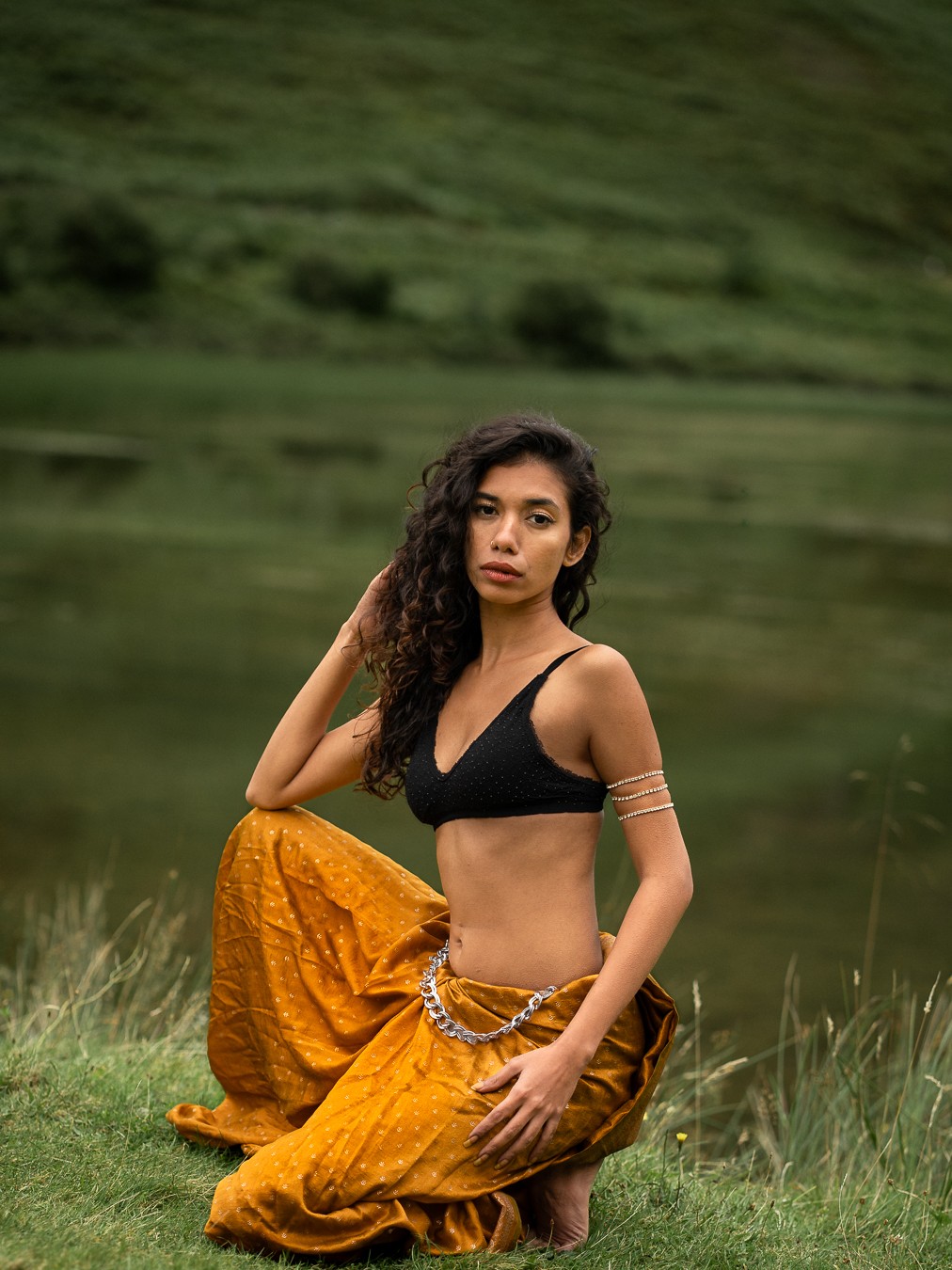
The saree was Roselitta's own — a yellowish mustard she already had. Nothing sourced, nothing bought for the shoot, which is almost always the better way round. A garment someone already owns is worn differently from one handed to them that morning.
Mustard was not a mood choice, it was a practical one. Glencoe in August is green, grey, and heather purple, under cloud more often than not. Cream disappears into the sky. Red argues with the heather. Black collapses into silhouette the moment the light drops. Mustard is the one thing in that family of colours the glen cannot swallow — close enough to the grass to belong, far enough from it to separate.
Silver at the waist and the wrists rather than gold, for the same kind of reason. Gold is warm and would have pulled the whole frame back towards Kerala. Silver is cold and meets Scottish light where it actually is.
Two Places Made of Mountain and Rain
Kerala and the Highlands have more in common than they look. Both are mountain country. Both are rain country, in their own fashion. Both have more water in them than the photographs usually admit.
I think that is why this did not feel like a novelty to shoot. A saree in a Highland glen could easily be a stunt — a garment borrowed for contrast, worn by someone it does not belong to, in a place that means nothing to either of them. That was not what this was. The silk is hers, she is from where it comes from and so am I, and the glen is where we both live now. The drape is not a traditional one — she wore it low and loose, closer to a dancer than a wedding — but that is a choice made from the inside, which is a different thing from borrowing.
With Thanks
To Roselitta, who brought her own saree and her own silver, drove out to a glen for a concept that existed only as a sentence, and wore six yards of silk in Highland weather without once complaining about it.
For more location-led editorials, see the candlelit shoot at Portencross Castle on the Ayrshire coast.
Shooting at Glencoe
Glencoe is free to visit and open all year. Most of it belongs to the National Trust for Scotland, bought in 1935 with money raised by the Scottish Mountaineering Club — the bulk of it from its chair, Percy Unna, whose conditions on access and management are still followed as the Unna Principles.
- The Three Sisters viewpoint car park on the A82 is the obvious stop and fills completely in summer. Early morning or late evening is the only reliable way to get it quiet.
- Stretches of the surrounding roads are single track. Passing places are for passing. Do not park in one to get a photograph.
- August means midges, and a saree offers no cover at all. Repellent, and keep moving.
- The weather turns in minutes. Glencoe Lochan, down near the village, is sheltered and wooded and makes a sensible wet-weather backup.
- It is a working landscape and a serious hill area. Keep the kit small, stay off the fragile ground, and do not treat the Lost Valley path as a studio — it is a real climb.
Commercial shoots at scale should be cleared with the National Trust for Scotland first.
Model and styling: Roselitta Sunny
Location: Glencoe, Scottish Highlands